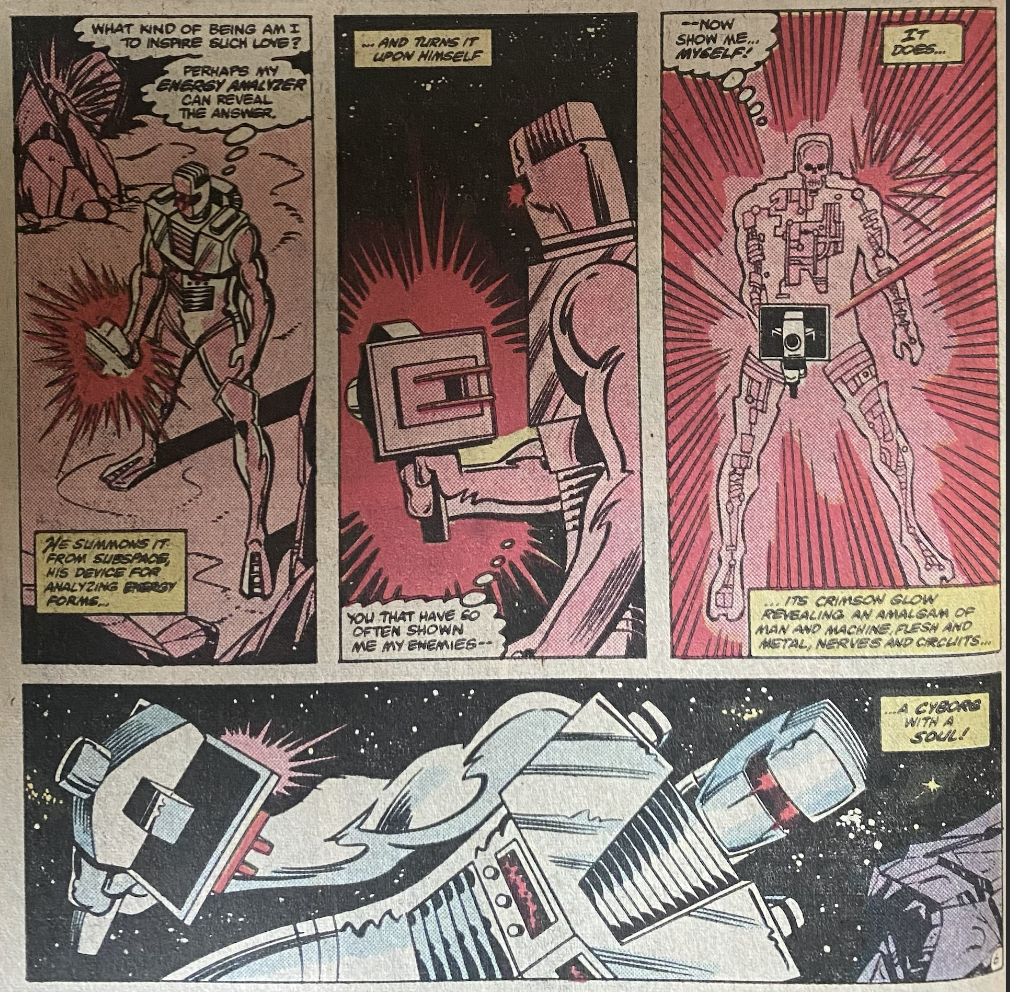
This article is the fourth in a 5-part retrospective on the original Rom series. Part 1 introduced Rom within the context of the other toy comics of the time, then Part 2 explored the way the series handles its villains in the context of propaganda and war comics, and Part 3 further reflected on how Rom’s portrayal of its villains is indicative of the Red Scare politics of the preceding decades. I would suggest you read those, but if you’ve read Rom before or are just curious, you can do whatever you want. Also see Who is the Real Rom Anyway?
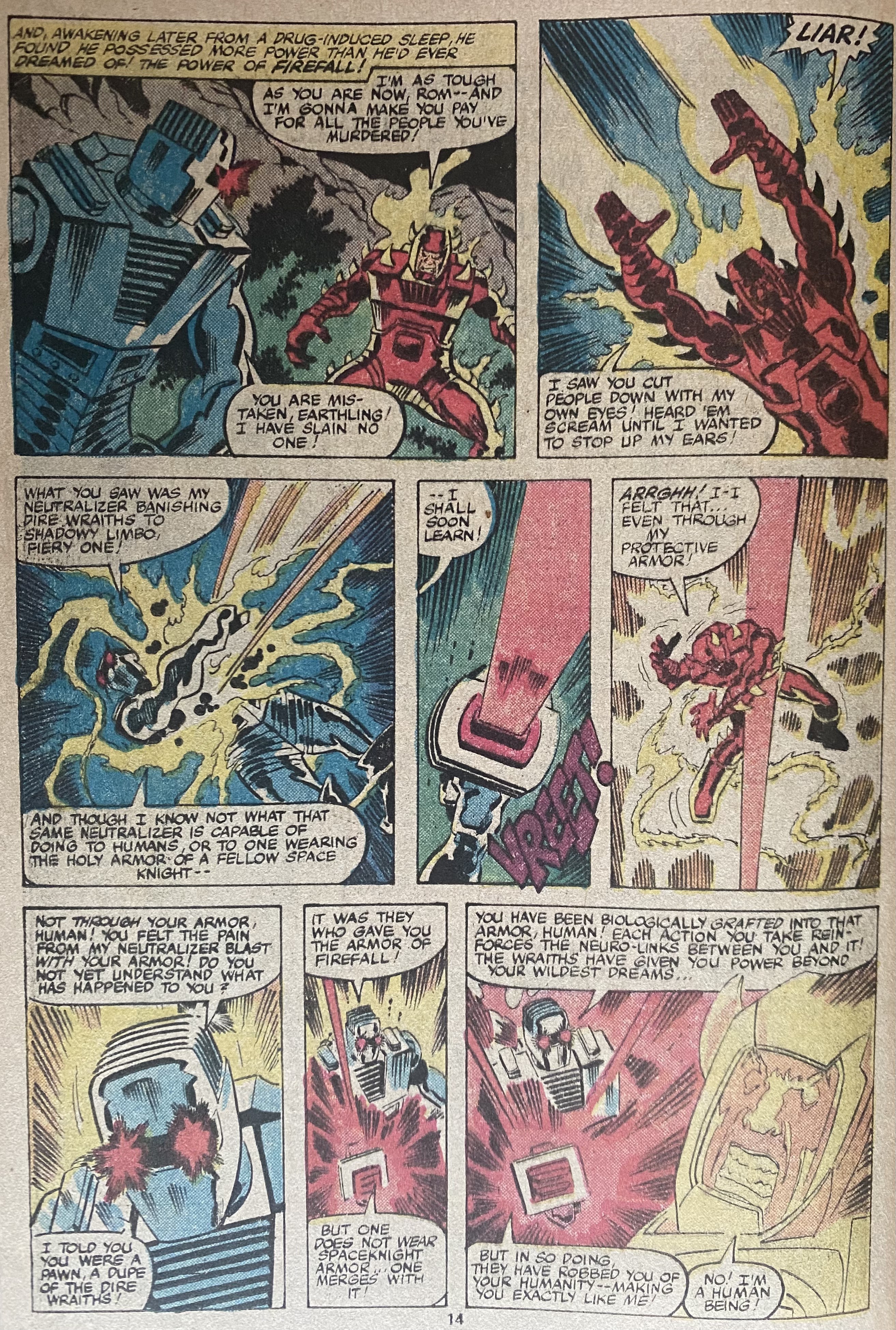
“ARRGHH!! I — I felt that…even through my protective armor!”
“Not through your armor, human! You felt the pain from my neutralizer blast with your armor! Do you not yet understand what has happened to you? I told you you were a dupe of the Dire Wraiths! It was they who gave you the armor of Firefall! But one does not wear Spaceknight armor…one merges with it! You have been biologically grafted into that armor, human! Each action you take reinforces the neuro-links between you and it! The wraiths have given you power beyond your wildest dreams…but in so doing, they have robbed you of your humanity — making you exactly like me!”
“No! I’m a human being!”
It doesn’t take long for the Rom series to give the titular hero a thematic foil. Rom — a loyal citizen of Galador — gives up his humanity to become a Spaceknight, so he can fight the Dire Wraith threat. He travels to Earth in pursuit of the Wraiths, who have used their shapeshifting powers to embed themselves into the highest apparatuses of power on the planet.
Enter Archie Striker, a former soldier and criminal given the chance to bond with a suit of Spaceknight armor. Striker readily accepts because he believes Rom is a threat to Earth. Like Rom, Archie sacrifices his human autonomy to become something more powerful, in order to fight who he’s told is the enemy. Unlike Rom, Stryker goes in blind. He doesn’t know what he’s giving up.
Rom and the new Firefall’s first encounter is swift and brutal. Firefall’s living flame arguably rivals Rom’s own abilities, but Rom’s experience in Spaceknight warfare wins out quickly. Stryker is left disgraced, disillusioned, and weary.


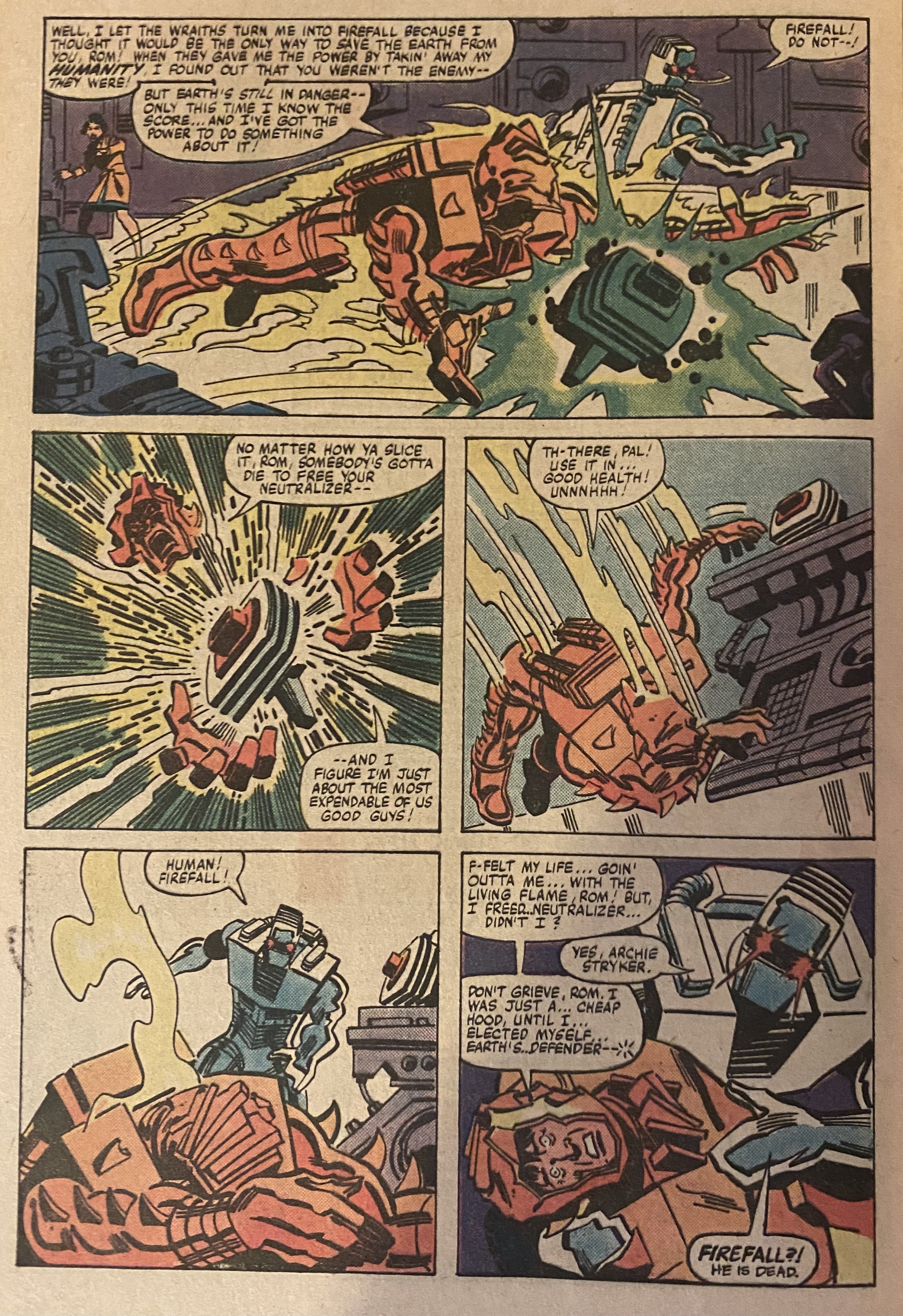
On their second encounter, Stryker knows for sure he’s been had. He knows the ones who gave him this armor are his true enemy, and he sacrifices himself to allow Rom to continue to carry on his mission.
For Stryker, who would otherwise face living a life in an alien metallic body unless Rom could miraculously send him to a planet he’s never seen, perhaps the decision is not hard. Some of his best impulses — to defend his home, to fight evil — were manipulated by the greedy and corrupt. He made a decision in a moment, but the toll to his body and mind were permanent.
Throughout Rom’s 75 issues (and 3 annuals), it’s clear the series is interested in exploring the damage war causes to the idealistic soldiers it conscripts. By the end, it offers a message of hope and restoration.
In between, it gets messy.
Shell Shock
At some point between the 19th and 20th century, men became machines. You could run diagnostics on their parts, place their wires under a microscope, and etch away the programming written in the wrinkles of their brains.
We started to discover it as people survived great destructions caused by the great machines man himself made. Doctors found that after train crashes the experience would stay in the minds and bodies of the survivors. The doctors hypothesized that the event settled in the spinal chord: the backbone took the shape of the accident itself, and warped the electric signals running through the rest of the body.
It didn’t take long to find that war caused this in soldiers, and that while it may not literally change the physical shape of the spine or brain, the effects were nonetheless real. The late great George Carlin best described how the name of the phenomenon itself changed over time:
“There’s a condition in combat. Most people know about it. It’s when a fighting person’s nervous system has been stressed to its absolute peak and maximum, can’t take any more input. The nervous system has either snapped or is about to snap. In the first world war, that condition was called shellshock. Simple, honest, direct language. Two syllables: shellshock. Almost sounds like the guns themselves. That was seventy years ago.
Then a whole generation went by and the second world war came along, and the very same combat condition was called battle fatigue. Four syllables now. Takes a little longer to say. Doesn’t seem to hurt as much. Fatigue is a nicer word than shock. Shellshock! Battle fatigue.
…Korea, 1950. Madison Avenue was riding high by that time, and the very same combat condition was called operational exhaustion. Hey, we’re up to eight syllables now! And the humanity has been squeezed completely out of the phrase. It’s totally sterile now. Operational exhaustion. Sounds like something that might happen to your car.
…the war in Vietnam, which has only been over for about sixteen or seventeen years, and thanks to the lies and deceits surrounding that war, I guess it’s no surprise that the very same condition was called post-traumatic stress disorder. Still eight syllables, but we’ve added a hyphen! And the pain is completely buried under jargon. Post-traumatic stress disorder. I’ll bet you if we’d have still been calling it shellshock, some of those Vietnam veterans might have gotten the attention they needed at the time. I’ll betcha that. I’ll betcha that.”
The Vietnam War coincided with the ubiquity of television, and thus was visible to the non-combatant public in a way no other American war was. The degree to which this impacted the strategy / policy / results is debatable, but the emergent media landscape added another sense and front by which warfare could seep into the collective psyche. All past wars would only be seen in retrospect, but the Vietnam War was the first watched live.
Literature and art’s relationship to war changed as well, though that was nothing new. As Terry Eagleton said, “Modernity regards self-dispossesion as the enemy of self-realization,” while “Postmodernity is equally skeptical of sacrifice, largely because it is uncertain that there is enough of a self to be relinquished in the first place.”
We’d become machines who could run our own diagnostics, and lament that we’re nothing but machines.
Machines who could angst.

Angst Machine
Rom is a love story. It takes less than the first 10 issues of the series for Rom and Brandy to catch feelings for each other. In the spirit of soap opera these feelings are complicated by Brandy’s boyfriend Steve, but there’s more than just a mediocre male side character standing in the way of our beauty and robotic beast.

Rom’s own emotional stuntedness is the chief obstacle. Brandy is the first human Rom meets after 200 years in space with no contact with anyone. More than that, emo is built into his circuitry: if there’s one thing Rom does well, it is fighting (sometimes killing) the Dire Wraiths, but if there’s two things he does well, one is fighting the Dire Wraiths and the other is lamenting the loss of his humanity.

Rom’s machine body marks him as disabled. In the language of Marvel Comics, disabled bodies are sexually queer, othered, or implied as castrated. Villains are markedly deformed, juxtaposed against heteronormative forms of masculinity and femininity. In one prominent example, Jose Alaniz in Death, Disability, and the Superhero explains,
“Dr. Doom carries precisely that trace of sexual vagueness (cowl, monk’s dress…dandy-like preoccupation with his body…), while his iron mask contains nothing less than the face of the Medusa, the classical symbol of the castrating female gaze…if the Silver Age superhero represents a (superficially) hypermasculine, ableist compensation for male physical disability and lack at a time of masculine anxiety (the Cold War), then the supervillian — its foil and structuring Other — must represent the return of that repressed, body-disrupting, feminizing force.”
When a hero takes on these same signifiers, the natural result is self-hatred. For a superhero whose appearance doesn’t conform to the masculine ideal, his own body is his foil.
By keeping Rom’s disability vague, the queer subtext intensifies. You notably never see the human remains of Rom. The comic never explains the details of the procedure except to say a large portion of his bodily tissue was removed and placed into storage. As Alaniz continues, “Too powerful and overdetermined a signifier, the double threat of castration and physical disability can never be shown, only hinted at, disavowed, deflected, literally marginalized by placing it ever and only just ‘off-frame.’”
Marvel stories about disabled machine men take love unworthiness as a logical outcome of this kind of disability. Iron Man curses his wounded heart whenever he gets close to a woman, while Vision struggles to get past his android body and identity to date the Scarlet Witch.

Heroes with these signifiers notably never invoke disgust in their love interests, though, who are always happy to look past unconventional appearances. These protagonists’s limitations are internal to themselves, a kind of noble impotence. The subtext tells us that any loss of physical ability can equate to a tragic loss of sexual prowess, and any loss of sexual prowess can equate to a loss of self-worth.
The promise of this story is that Rom will be whole again, but he won’t be able to do it by himself.
Manic Spaceknight Girl
Brandy serves the story as a prop for Rom’s emotions for a while, but eventually the story takes her to dark places, as she’s transformed into a Spaceknight by a wizard (a Space-wizard, even) against her will. When her and Rom finally return back to her town in West Virginia, she finds her family, Steve, and nearly the entire town slain by Wraiths.


The new Starshine metamorphizes into a killing machine. Rom hates the Wraiths for stealing him away from the life he could have had, but for Brandy it’s more personal. The need for vengeance fuels her hatred.
One could criticize her undying rage as racism, if the comic didn’t pretty much agree that all Wraiths are irredeemably evil (see previous installments). Instead, the anger pumping through her heart is bad for the damage it does to herself. It steals away the soft, loving creature she was and replaces her with hard, unlovable metal. If Rom‘s message about masculinity is that disability queers it, Rom tells us that for femininity disability — and grief — eradicates it.
The story isn’t really as interested in what this transformation, rage, and grief mean to Brandy herself as it is interested in what it means for Rom, though. While Brandy’s transformation threatens the romantic relationship between herself and Rom, it also provides Rom a mirror to his own past, present, and future.
Right before Brandy’s transformation, after all, Rom was at his lowest. He lets his rage absolutely consume him to the point where he kills wraiths in cold blood instead of transferring them to Limbo. Seeing the new Starshine do the same, his own soul softens, and his conscious hardens. He learns to be human again.


So of course Rom resolves this contradiction by returning spaceknight Starshine to the human Brandy. The plot mandates the transformation, as the villainous Hybrid uses her as a pawn in his revenge against Rom. She has less agency in this reversal than she did in the original change.
See You Space Knight
Little more than a year later, Rom himself gains his humanity back in the final issue of the series. Both protagonists cleared of all markers of disability, Rom and Brandy’s love can finally reach consummation.


To get to this point, though, Rom must face the morbid end stage of his planet’s militaristic ideologies. He returns to Galador at last, only to find that the entire population of humans is dead, slain by a new contingent of Spaceknights who razed the planet during their construction of an oppressive security state. These Spaceknights are his ultimate, final, foil, a true antithesis of everything he’s learned to be valuable and true.

Rom is faced with a choice. He can give in to the ideology of the fascists, and forsake his own humanity for power, or he can find another path by accepting the value in himself.


He follows the second course, embracing his humanity instead of rejecting it. Despite all of Rom’s siloqueys and private complaints throughout the series, at the final confrontation Rom resists cynicism. He rejects death, and holds onto life.
Taken generously, the ending of Rom is a metaphor for renewal. Whatever a war transforms a soldier into, there’s hope for healing. Trauma changes people, that’s inevitable. However, if we accept that it can irrevocably steal someone’s humanity away then we’re buying into the big lie that war depends on: that men are disposable machines.
In factuality men are closer to trees. They need a season of spring to heal from a long, dark winter. This metaphor of rebirth is maybe Rom’s greatest strength, even if it clumsily plods through minefields to get there.
One can connect the metaphor of soldier PTSD to a larger critique against military states and imperialism. Even if Rom is lacking in its understanding of the politics of the enemy, its interrogation of the military industrial complex is more layered and interesting.
That will be the subject of the fifth, and final installment of this ROMstrosepective.
— Ben Rathbone is the creator of this site, and its only writer. Don’t find him anywhere.
Leave a Reply