If there’s anyone who’s cracked the code to death, it’s the comic book folks.
It’s hardly a tragedy, but an event. An obstacle to overcome, or a moment of ever renewing inspiration for our hero.
Death happens like clockwork in the comics. It follows a clear rythym of ad copy and resurrection, a drum beat machine that hits itself for attention if no one is listening. The deaths give birth to themselves, such as Dr. Strange and Ms. Marvel both “dying” as their movies hit the big screen. Let’s all remember that when Superman died his TV persona was poised to get married.
There’s patterns to stories about death, and some of these are unique to comics as a medium. A. David Lewis defines six elements of the superhero genre present whenever heroes travel to the afterlife: presence and travel to an alternate dimension, a demon/adversary/Alastor figure to be overcome, heroic reversal or characters acting contrary to their normal natures, familial encounter, hallucination, and character liberation. Not all are always present, but more than one always is.
While characters will often travel to the afterlife in a story where a character dies and resurrects, often they do not. In the latter case, there are still features that define these stories. During my own study of comic book death and resurrection (see the podcast Not a Hoax! Not a Dream!), I found that at least one of four features are almost always present in a superhero comic death / resurrection cycle: impersonation, posession / brainwashing, amnesia, and displacement of temporal or spacial locality.
These features can appear in various ways, or at different points in the death to resurrection arc. When Jean Grey dies at the culmination of the Dark Phoenix saga in X-Men #137, John Byrne — with an assist from a young Kurt Busiek — figured the best way to bring her back would be to reveal it wasn’t actually Jean Grey at all, but the Phoenix force masquerading as her (possession, then impersonation). Meanwhile, after Superman’s battle against Doomsday turns fatal, five “Supermen” pop up in Metropolis (impersonation), before the real Superman later resurrects in issue # , his memory temporarily foggy (amnesia).
Professor Xavier’s death and ressurrection in the 1960s is one of the most classic of these cycles. Spanning 23 issues, the X-Men spend close to 2 years without their mentor. Charles’s own Doomsday was an underground miscreant named Grotesk the Subhuman, and the explanation for his resurrection is that it wasn’t really him that died, but was instead a former shape shifting villain named the Changling.
So we have an example of impersonation, and Charles Xavier fits nicely into my hypothesis, along with Superman, Phoenix, Spider-Man, Batman, and near countless other heroes.
The thing about Charles, though, is that he dies again. And again. Looking at death as a singular, life changing event in a comic book character’s continuity is one thing, but what happens if you die twice? Three times?
What happens when you die over and over again?


Solve for X
Before we discuss Xavier’s second death, we have to figure out what it is that’s dying. Comic book characters are variably defined, since they’re written and depicted by a string of different writers and artists and editors, subjected to never ending reboots, reconceptions, and other fancies of company mandate or poetic license.
Debatably Professor X isn’t fully created until somewhere between Uncanny X-Men #117, where Xavier’s motivations for forming the X-Men are forged, and #161, where Charles’s past with Magneto is revealed, and their opposing ideologies are fleshed out as foils for one another. Before writer Chris Claremont takes on stewardship of the character in this era, the professor is a macguffin, barely distinguishable from the Doom Patrol guy some claim he was copied from, or functionally the same as Zordon from the Power Rangers, a big face who gives purpose for the team’s formation and sets up each episodic mission, but otherwise isn’t the source of any of the main dramatic content.
It’s also in and around this era that the mutant metaphor starts really metaphoring. Uncanny X-Men #141 – 142, the Days of Future Past storyline, shows us a dystopian future ruled by fascist robots, where mutants are hounded into concentration camps, and the metaphor only escalates from here. God Loves, Man Kills presents an evangelical bigot who sways the public against mutants, Uncanny X-Men #235 introduces the island Genosha as an allegory for apartheid South Africa, and in the 90s we see the Legacy Virus, a thinly veiled commentary on how AIDs impacted the gay community.
If mutants themselves come to represent any oppressed class or race, how should we think of the de facto head mutant, the leader and creator of the X-Men, Professor X himself Charles Xavier? Is he better understood as political advocate? Messiah? Strange financial backer of an anarchist paramilitary compound fronted as a school? Is he the Martin Luther King to Magneto’s Malcom X, as yesterday’s misinformed dweebs so often parroted?
There’s another popular answer to this question, based on interpretations of multiple interviews with Chris Claremont. It’s only a satisfying answer in that it does dispel the Xavier/MLK Magneto/Malcolm myth, and there was a time when many (myself included) left it at that and didn’t give it any further thought. Once you do give it that thought in the light of history, it can take the X-Men into some awkward (and fair warning, dark) territory.
Is Charles Xavier a liberal Zionist?
Xavier’s Dream
Charles Xavier first makes his way to Israel during a gap year travel abroad in the Mediterranean, his last stop Egypt, where he encountered the very first “evil mutant” that will eventually inspire the creation of the X-Men, the Shadow King. “Evil” is in this case an Orientalist depiction of a decadently overweight man in shades, fez, and a suit, who transforms into a horrific demon in the psychic realm they do combat in.
After recounting this story to his space alien girlfriend, Charles summarizes thus: “Amahl Farouk was the first evil mutant I’d ever met, the first who made me realize how truly deadly mutant powers could be in the wrong hands. Then and there, I found my life’s work — to bring mankind and its mutant children together in peace and harmony, and to protect humanity from creatures like Farouk.”
It’s after this episode that Charles makes his way to Haifa, where a Korean war veteran friend introduces him to Magnus, who astute readers will recognize as a younger but already white haired Magneto. Uncanny X-Men #161 is a fascinating case study in the form of long term comic book narrative, where Claremont upends everything you know about these characters in a story so natural it’s retroactively persuasive: of course Xavier and Magneto were friends before they were enemies, it’s hard to imagine it any other way.
Claremont’s fictional portrayal of Israel is also persuasive at first read, an unproblematic post-war haven of healing. When the antagonists of the flashback finally arrive with laser guns blaring, an unammed soldier briefly wonders if it’s “Arab commandos” or “terrorists” — his captain hopes not given their advanced technology. This aside is swept away by the revelation that the attackers are German. Nazis are present everywhere in the story, in dreams, as psychological scars, and as tangible villains in the form of Baron Von Strucker and Hydra, but besides the soldiers’ brief lines and an earlier mention of a “divided Jerusalem” there’s no other acknowledgement of indigenous Palestinians, or of Israel as a contested land.
As an expression of Holocaust survivor trauma, the story excels in the way graphic narrative uniquely can. Artist David Cockrum’s visualization of Gabrielle Haller’s subconscious visions depict a hideous green ogre Nazi with long teeth, protruding tusks, and black eyes, garbed in Nazi attire and firing a machine gun. The blending of nightmare fantasy and industrialized fascism foreshadows the actual Nazis return to kidnap her 4 pages later. In those 4 pages, Haller slowly learns to live again, but for a survivor of genocide the horrors never truly end.


Claremont’s Israel is influenced by his own visit to the country as an impressionable college student, when he volunteered to work on the Kibbutz Netiv HaLamed-Heh. The scribe speaks admirably about the experience, such as in an interview with Empire where he cites it as his influence for making the X-Men stand ins for persecuted groups: “It affected me on levels that I hadn’t anticipated, working on a daily basis with people who were actual survivors of the Holocaust. You’d see military patrols going by every day. We would have armed volunteers walking around the property all night. It brought home international conflicts on a very personal level.”
In the same interview, Claremont also credits the experience as the origin of his signature interest in strong women characters: “There is nothing so disconcerting as sitting on a a bus and having a young lady walk on with an Uzi flung over her shoulder. In 1970 you weren’t used to seeing someone you might ask out on a date packing hardware. So it’s taking that realisation and applying it to the fictional reality of the X-Men and seeing where it leads.”
Netiv HaLamed-Heh is often referred to as a socialist Kibbutz, meaning the land was worked according to a model of equal work and to equal benefit. Demobolized Israeli soldiers established it in August 1949, after the army depopulated the village of Bayt Nattif and surrounding lands starting in October 1948. The circumstances of the original conflict between the villagers and the Haganah / Palmach soldiers is debated, but the resulting death of 35 Israeli combatents was used as justification for the ensuing destruction and clearing of the area, which according to 1945 census numbers would have included over 2,000 residents.
This was all part of a larger operation to secure an uninterrupted highway between Jerusalem and Tel-Aviv. An official military document lays out the mission as “the destruction of villages or objects dominating our settlements or threatening our lines of transportation.” The Israeli Air Force bombed the village on October 19th 1948, the Fourth Batallion of the Har’el Brigade demolished the houses and vacated the residents on October 21st, and the brigade returned to the area on November 5th to drive out all Palestinian refugees still remaining. Today, Netiv HaLamed-Heh is home to the Vertigo Eco-Art Village, founded “by a community of Artists who wished to live, create, explore and connect their Art to the earth and the environment.”
Probably the biggest influence Claremont’s understanding of Israel had on the X-Men is his conception of Magneto, who he’s on record as modeling after Machaim Begin, the seventh prime minster of Israel and founder of the right wing party Likud. Claremont saw an arc of hopeful redemption in Begin, who was a terrorist before his political career, but in 1978 signed the Camp David accords peace agreement between his country and Egypt. He saw in this a poetic fulfillment to Magneto’s story, to go from pratictioner of violence to advocate for peace (unfortunately, Begin’s own arc would not end in peace: in June of 1982 — the very month Uncanny #161 hit stands — he lead the invasion that sparked the Lebanon War).
As Magnus and Charles develop their friendship and share their thoughts about the future of mutantdom, their emergering ideologies clash. Magnus says, “Charles, you are an idealistic fool. If mutants exist, humanity will fear them and out of that fear try to destroy them. There is only one way to guarantee the survival of Homo Superior, and that is for them to hold the reins of power.” This line has a revolutionary feel. If we imagine Claremont already having Begin in mind as he writes this, we can remind ourselves that Begin fought the British occupation of Palestine in the name of Zionism before he began his political career. It’s in this resistance fighter to totalitarian energy that lies the foil to Charles Xavier.
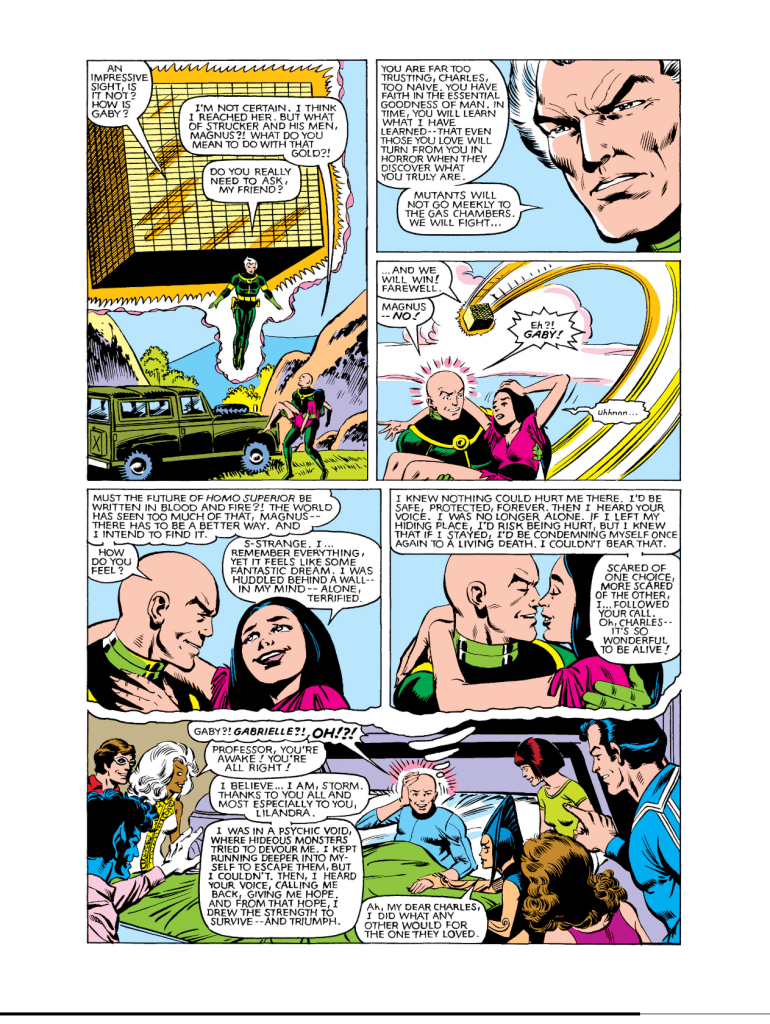
The story moves on before we can see if Charles mounts a rhetorical defense. His counter instead comes in a thought bubble later on: “Magnus is wrong, such security cannot be imposed by fear from above. It must grow from understanding.” It’s not insignificant that he distractedly thinks this while on a date with Gabrielle Haller, who he’s also treating as a patient, maybe giving credence to Magnus’s “idealist fool” characterization.
Later on, in the climax of the issue, after Magneto has buried Nazis under rubble and reclaimed their stolen gold, he repeats his criticism of his friend: “You are far too trusting, Charles, too naive. You have faith in the essential goodness of man…Mutants will not go meekly to the gas chambers. We will fight…and we will win!” Charles again doesn’t mount a verbal challenge — Magneto already flying away — but instead thinks it: “Must the future of Homo Superior be written in blood and fire?! The world has seen too much of that, Magnus — there has to be a better way, and I intend to find it.”

Various sources will also sometimes mention David Ben-Gurion — the first and third prime minister of Israel — in relation to Machaim Begin as the inspiration for Xavier and Magneto’s relationship. Claremont is only quoted in terms of Magneto and Begin, but this would make sense considering the two historical figures’s interactons. Ben-Gurion, the leader of the liberal Labor Party, for most of his life despised Begin, who he considered a violent extremist. Both men ultimately believed in Jewish sovereignty over the land they define as Israel, whatever that may mean for Palestine.
Is the difference in the methods, the politics, or something else? For Magneto, he will protect mutants at any cost. For Xavier, “any cost” is too high, but the costs he will pay when the world doesn’t match his idealist fantasy, and the fallout of the risks he won’t take when that fantasy crumples, are ill defined. Xavier’s dream is a future where humans and mutants hold hands, but his day to day operations is a hidden bunker, teenage soldiers, and a psychic surveillance state where he decides which mutants are good and which ones are bad. Professor X’s posture could be read cynically, that as long as his actions are not publicly distasteful, and the desired end is pure, he’s in the right.
Charles is a liberal. “Liberal” is one of the most contentious political adjectives of the modern day, one of those words for which official definitions are sometimes unhelpful. For other self-identified liberals, it is understood as the counterweight to conservatism, while to right wingers and left wingers alike it is a slur to be hurled against what they consider to be ineffectual or harmful politics.
What’s indisputable is that Xavier’s dream is a liberal one, and is meant to be understood as such. It places him at odds with both the reactionary humans who hate and fear mutants, and with fellow mutants like Magneto and Mystique who use differing tactics to fight back.
Between #116 and #161 we have the basic building blocks of the man…and the essential contradictions. Charles Xavier has seen the reality of how dangerous mutants can be, and has seen a future where humans will fear and oppress them. He wants to foster a world where humans and mutants understand eachother, but he considers it an important part of this work for the good mutants to clean house, to curb the threat evil mutants represent to the public. This is how a would be pacifist ends up creating a paramilitary organization dressed up as a superhero team, that operates out of hidden bases underneath a private school in Weschester.
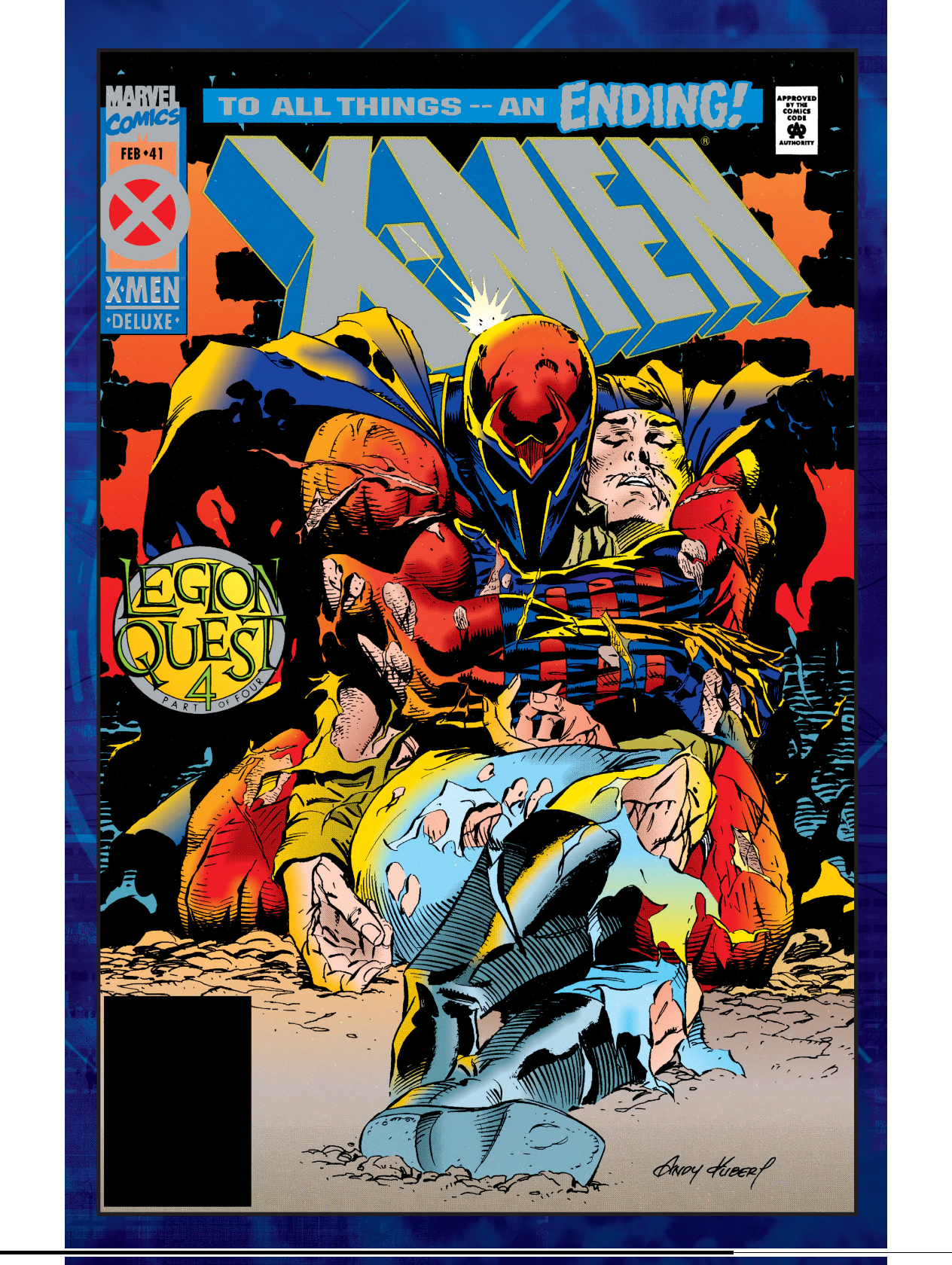
When he dies in 1994’s X-Men #41, it will be the past version of him we see in #161 that’s killed. He dies at the gestation of his dream, before he can form the X-Men. In this way it is not just a bodily death, but a death of his ideas. A complete death. This story will not just be about a man. It will be an interrogation of everything he is.
For We Are Many
We’ve looked at the victim. Now let’s meet the assassin.
We meet Legion the next time we return to Xavier’s backstory in Israel in a major way, in New Mutants #26 – #28, where Charles finds out he has a son with Gabrielle Haller. David Haller, now a young adult, has been comatose since childhood, when him and his mother were attacked by terrorists. David’s mutant psychic powers manifest at that moment, and wipe the minds of the attackers. For one of the terrorists, a young man named Jemail Karami, his mind was absorbed into David’s consciousness and has lived there in the years since, along with two other personalities: a sadistic American adventurist named Jack Wayne, and a female pyromancer named Cyndi.
Over the course of David’s history, he is assigned a smattering of diagnoses: autism, schizophrenia, dissociative identity disorder. Bill Sienkiewicz’s art is the perfect match for a story about the chaos of an internal mind, as he scratchily and wildly renders warped and grotesque features across all the cast of characters and terrain. The art is a contrast from David Cockrum’s more traditional superhero style in #161, and it signals a darker, more pessimistic atmosphere.


By the end, in a twist, Jemail Karami has been working to save David for years, since his time in Haller’s mind has softened his violent nature and taught him to admire the people he formally hated. Jemail’s greatest adversary in the story is the Jack Wayne personality, who relentlessly attempts to turn Xavier and the New Mutants against Karami, convinced that the only solution to save David Haller is to murder who he constantly refers to as “the Arab.” When Wayne is proven wrong, so is Gabrielle Haller, who also wishes Karami’s psychic destruction before his true intentions are revealed.
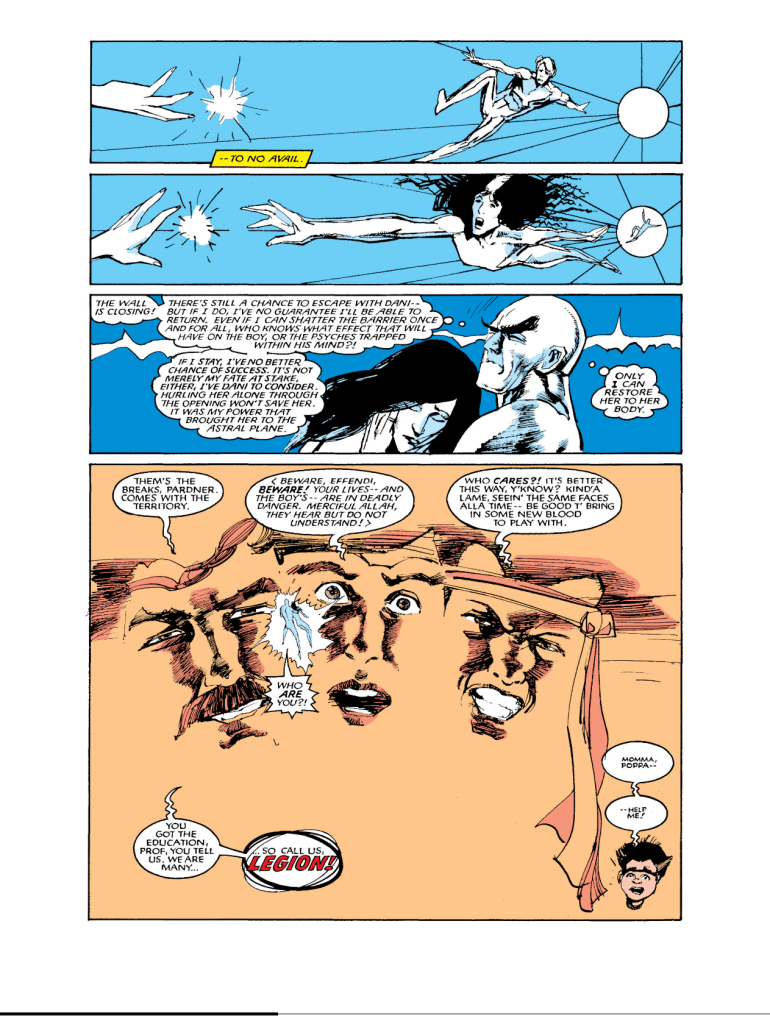

Despite all this, in some ways Karami is an Orientalist characature as bad as the Shadow King. His motivations or ideology or spiritual beliefs are a mystery, presumably because they are not even considered, let alone weighed to be important. Before his moment of redemption, when he also conveniently learns English, he’s denied any voice or agency, and his story is never truly told. His change of heart doesn’t happen through any kind of dialogue or exchange of ideas, but simply as the result of him being there, a receptacle for the love and forgiveness of David. An empty cup before, now filled with the light of understanding.
David would come to be named after this story, Legion, a reference to the new testament biblical demons that first possess a man, and then a herd of pigs after they’re excorcised. While he starts with 3 personalities, he’ll eventually end up with more, and more. In Uncanny X-Men #255 he ends up killing — somewhat poetically — the character Destiny, and shortly after ends up in a coma again.
For Charles Xavier, his son Legion represents an even more dramatic foil than Magneto. After meeting one evil mutant in Cairo, Xavier dedicates his life to countering them, so that they won’t get in the way of his dream of peaceful human and mutant coexistence. His own son is a comically exaggerated embarrassment, a betrayal of his mission. A shameful call from within a shattered glass house.
This view that humans will ultimately have less reasons to fear and hate them if they fight the ones that should be feared is a facile viewpoint, a fictional state of order that lives rent free in the brain of naiive moderates, self-interested reactionaries, or, pointedly, white male comic book writers.
Nonetheless, Legion agrees with his father, coming to the conclusion that if Magneto had never existed, Xavier’s dream would already have come true. In one way, you could call Legion’s viewpoint a twisted mirror of Charles’s, but from another viewpoint you can see it as a natural and logical extension. Legion’s failed attempt will have disastrous consequences. What comes next will overshadow the question of just how much of those consequences were blowback from Xavier’s own personal follies.
Memories
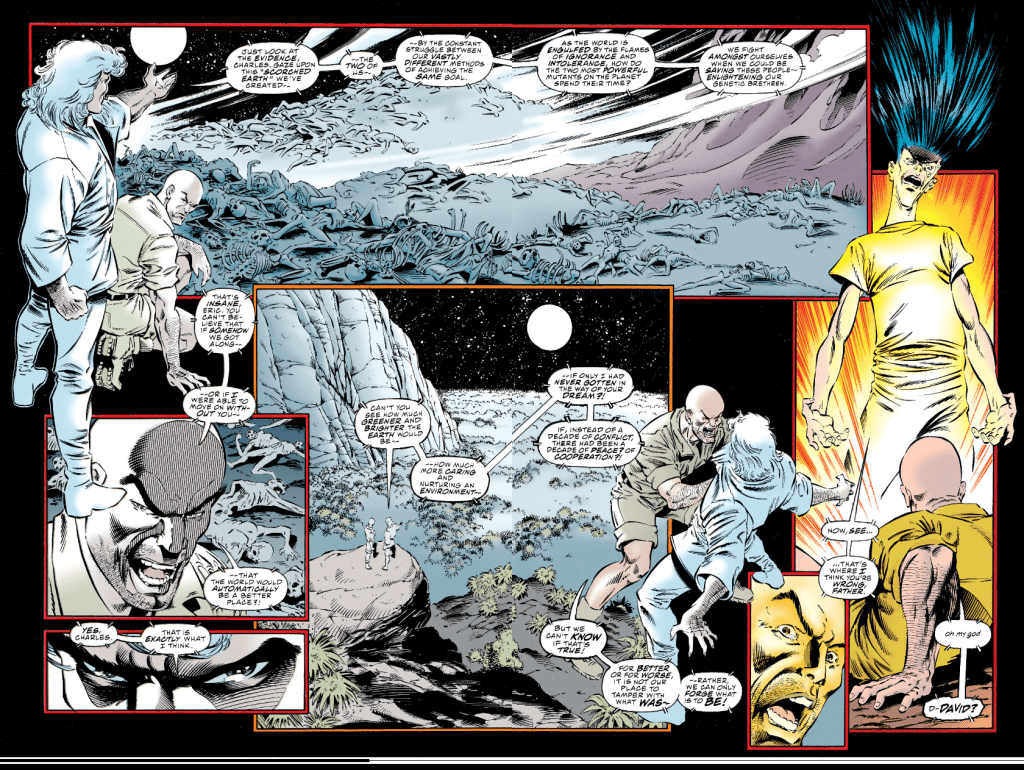
In Uncanny X-Men #319, only a few issues before his death, Charles dreams. We see not the conceptual dream of a world without hate, but the man asleep and the visions that echo through that slumber. He dreams of Israel, a Palestine of traquil, empty plains and a night sky of stars, peaceful enough for him to share a quiet, longing conversation about the past with his old friend Magnus. Magnus insists that Magneto was a poison to Charles’s life effort, that it’d be better he was dead before he could cause any harm. Xavier denies this, but Magnus continues to press.
The tranquil plain becomes a field of corpses, the quiet conversation becomes hostile, and Magnus transforms into Legion. Xavier wakes up.
Once the story brings the characters to a non-dream 1994 Israel, the X-Men file out of the newly landed blackbird to find a united force of Israeli Defense Force and the Palestinian Liberation Organization. Iceman calls it the Twilight Zone, commenting that if the threat could make the IDF and PLO work together, the X-Men are “gonna get ripped.”
That threat is the newly awaked Legion, and Bobby is correct; the team of mutants’ collective strength pales in comparison to Legion’s psychic powers. During the ensuing battle, David reveals a new superpower, as he drags Storm back in time to the moment of her parents’s death, and back again, taunting her that she didn’t react in time to change anything. Legion plans something different. He ends the skirmish by rocketing to the past, and several of the X-Men are dragged into the current of temporal energy along with him.
Once we enter the time travel phase of this story, in enters one of our familiar, friendly features: amnesia. Time travel in this story — at least for the Legion express variety — comes with the price of temporary amnesia, and that includes Legion himself. This allows David to confront his assassination target with fresh eyes, and psychichly project the trauma Magneto went through. The loss, the pain, the rejection of his wife, all tied to the onset of his powers, and when Magneto lashes out in response, David is left crawling on the floor, apologizing.


The next time we see Legion marks the second of our features: impersonation. Now that he remembers the reason he’s returned to the past, David chooses to transform himself into the likeness of his father and pay a visit to his mother. David imagines his father as a great man of history, who could remake the world in his image without interference, before passionately embracing his mother, who still believes him to be Charles, and dipping her off panel. If Xavier’s death wasn’t foreshadowed before, this strange Oedipal moment makes it plain.


These features — amnesia and impersonation — signal to us that a drastic change is happening. Death in dreams and other iconography like Tarot signals drastic transformation, the kind that can feel like an ending, or may be one, and that could explain why memories and identity start to get more fluid when a medium that uses narrative art explores death and resurrection. Could this story have worked without amnesia or impersonation? I’m not sure. I do know that these features are like sign posts directing us along a well travelled road.
X-Men #41‘s cover shows you a lifeless Xavier held by Magneto. Both characters’s anatomies are angled in Andy Kubert’s signature style, but while Charles appears utterly human, Magneto is fully garbed, muscles rippling, his face obscured by the dark shadows within the face opening of his helmet. The cover first dehumanizes the classic X-Men villian, and then humanizes him through the context of what he’s doing: holding the fresh corpse of a friend.
The first line of the comic spoken by Storm sets the stage: “This cannot be happening!” To stress the momentousness, on the next page Charles announces that this is the dawn of homo superior, and that a genetic bomb is going off above their heads while Legion and Magneto fight. When his powers fail, Magnus attempts to stop Legion with words. He’s an innocent man, whatever he does in the future, his course possibly already changed by what David has done even so far. But David insists that the world is a terrible place because Charles spent too much time fighting him. For that matter, Charles spent too much time fighting Magneto, that he didn’t have time to help him (on the personal note, he doesn’t consider that that could be a failing all of Charles himself).
We never get to see what a world where Magneto dies now looks like, because Xavier sacrifices himself to save him. This kind of death, the death of a man in his very best moment, in the prime of his ideals that have yet to hatch, is, like we said, a complete death. A death in body and mind, but also a death in form, and idea.
The reverberations of it are consequential.
It sends the X-Men to Hell.
Don’t Look Back
Okay, I don’t mean Hell literally. But saying it is figurative may put too light a touch on it. Returning to A. David Lewis’s elements of the superhero afterlife, the Age of Apocalypse fits several.


First, Bishop arrives to the Age of Apocalypse with distinct, but inconsistent (amnesia, continued) memories of an alternate past, marking this timeline as an alternate dimension to the original one. Bishop is our Orpheus and our Eurydice, who is travelling to the underworld, and must be freed.
While here, we meet dark funhouse mirror versions of characters we thought we knew. X-Men leader Cyclops is a slavemaster, while the fun loving Beast is a twisted, sadistic mad scientist. Cyclops’s brother Havok is a jealous, vengeful psychopath. Normally heroic B-listers like Richtor, Northstar, Aurora, and Cannonball are all loyal soldiers to Apocalypse.
Then there’s Apocalypse himself, the Egyptian mutant who has lived more than a millenia, who believes in the most extreme version of survival of the fittest. He serves as the ultimate ruler of this reality, the demon/adversary/alastor of this hell. Apocalypse does more than just lord over his forces, but tests and tempts both them and the protagonists of the story. Characters find salvation or damnation based on Apocalypse’s tests, as Strongman sells his friends out to save his beloved Lila Cheney, and Colossus abandons the Gen Next team to save his sister. Cyclops resists Apocalypses’s influence, and ultimately becomes a hero.
Before they can resurrect Xavier and set the world to rights, our protagonists will need to bring this afterlife portion of the story to a natural conclusion, by liberating Bishop, the one character not changed to fit this new world, but instead trapped here from the original reality.
The mission to liberate Bishop and send him back to correct the timeline, and thus erase the dark reality they’re in, is multifaceted, involving them freeing Illyana Rasputin from a madman’s prison, traveling to the far reaches of the galaxy to steal a shard of the M’Kran crystal, and retrieving the mutant Destiny. When things go awry, our heroes must confront Apocalypse in his fortress to bring all these pieces together and send Bishop back at last.
The mission is a success, bringing hope and restoration to the world at last. But how definitive is a victory if it is a return to the status quo? The time travelling son of Cyclops and Jean Grey, Cable, proves that there’s still a future where Apocalypse wins. For the ancient mutant, it is not a matter of whether he wins, but when.
Rather than celebration, the X-Men’s return to status quo is marked by tragedy. Beast’s reporter girlfriend announces to the world a link between the dangerous Legacy Virus and mutantkind. It’s a move that will likely increase prejudice against mutants. Shortly after, a mutant seeking refuge in the Xavier institute is murdered by a group of humans right outside the estate. Charles and the rest of the X-Men arrive too late to do anything to prevent the murder or to save the mutant from death.
Is Apocalypse right, and is it just a matter of when rather than if? Is his hell inevitable? Is total fascism just around the corner? Will ecological ruin and climate collapse outrun the future of humanity? And if the restoration of Charles Xavier’s status quo liberalism — or any status quo liberalism — only delays the inevitable, shouldn’t we try something else?
Or Xavier’s dream can die again and again, each time resurrected unchanged, each time flawed like the time before it. The gears turn, but the clock unchanged.
It’ll take the next time Xavier dies and resurrects to confront this question. In AvX, Cyclops and the other X-Men are endowed with the power of the Phoenix Force, and use it to reshape the world for the better. The Avengers are distrusting of their motives, and ruin the new utopia, and in the splintering of the forces, Cyclops attains all of the Phoenix power and goes mad from the surge of power. When Xavier joins the Avengers and X-Men to confront his former student, Cyclops kills him.
In the aftermath, the depowered Cyclops leads a different, more revolutionary brand of X-Men, and when Xavier finally does resurrect again, it isn’t long before he joins with Magneto and Apocalypse to found Krakoa, a new mutant project that aims to actively take on the rest of the world rather than passively wait to respond. This time, the clock actually turns.
Whether to salvation, or to ruin, it’s a story for another time.
— Ben Rathbone is the creator of this site, and its only writer. Don’t find him anywhere.
Leave a Reply